After Toronto and Cannes,
Nandita Das is ready to show her 'Manto' to the Indian audience, which, according to her, “is neither a small independent film nor a typical Bollywood blockbuster. It’s somewhere in the middle”. She doesn’t think the film is only for a certain audience – just as Manto’s writing was “so accessible”, she says, and “it’s often our arrogance that we think we will understand, but the common person won’t”. She explains what it was like telling a very intimate story about a legendary writer, who’s “struggling to just be himself when the world is not letting him”, and why telling the story of a provocative writer need not be so for the sake of it. Excerpts:
From what one understands, Manto’s following is the stuff that fierce literary fandoms are made of. Book lovers are known to be especially zealous when it comes to movie adaptations of mere books. You’ve said in this context that dar kar koi kaam nahi kiya ja sakta…… (Smiles) Aur Manto par, khaas taur se. Aur waise bhi mere liye acting aur direction, it’s not a profession. They’ve always been a means to an end. As an actor, I was trying to be part of stories that I thought were important to tell; as a director, more so. That you are getting a chance to tell a story that is compelling you. So if you have that fear of failure, you could never do that. And everything is subjective when you are interpreting a story, but I’ve been very true to what actually happened, and I think I also became very close to the family.
I almost felt like I owe it to them, like it was a moral responsibility. And I know that in fiction, you can take a lot more liberty, but somehow, I didn’t think of it as a biopic… I just wanted to tell a story that would help me respond to what’s happening today, and be as true to what happened, because that in itself is so interesting, fascinating and relevant.
Give us an idea of the kind of reactions you have had from different kinds of Manto’s lovers – positive, negative.Manto lovers are everywhere. In Toronto, somebody walked up to me, who’s read everything, probably more than me. I even met a Frenchman in Cannes, who had read everything on Manto, he presented 'Thanda Gosht' to me as a single story. Ya jaise Mumbai mein screening thi, ya Hyderabad mein, Kolkata mein, I have met a lot of Manto admirers. In fact, I met somebody from London called Nasreen, she saw one of the screenings, and she wrote to me saying, ‘I was there wanting to be critical of the film. But I loved it’. And Manto’s daughters, and their family, they were so moved by it. They were also like hawks watching it, especially the youngest daughter, she has done a lot of work on Manto’s works as well… Of course, I’m not here to please everyone, and everyone may not be pleased. But then, fair enough, you know.
Have you had any feedback in terms of a woman doing this job? Or is it especially fitting because Manto’s writing was so feminist?(Laughs) When I was in Cannes, a lady walked up to me and said, ‘I knew this was made by a woman’. And I asked, ‘Why do you say that?’ She said, ‘A subject like this, had a man done it, there would be a lot more violence and sex. And both would have been justified, in a way’. Personally, I don’t like seeing violence in films. I know that’s a whole genre and I’m not judging it, but I don’t like seeing it. And I’m always more curious about the impact violence has on emotions, and the psychological impact. 'Firaaq' was also a lot about that, the aftermath of violence. And also about sex. Because having been an actress, I know that we don’t have the eye to look at skin or any kind of nudity or exploring sexuality in a way that everybody understands the intent. And I didn’t want to take any of those liberties and make any of my actresses uncomfortable. Maybe it was a stupid reason, but just having been there and having faced those things where it distracts you from the crux of it, and Manto’s stories were not about that. And I felt that if he had to make a film today, maybe he would have done the same. Earlier, I used to say, I hate this label of woman director, yeh kya hota hai? I’m a director. But the fact that we say we want more women directors, we want the female gaze as well, we want diversity of stories and perspectives... Then I have to first own that myself. So nowadays I say yes, I am a woman director, I am a director who happens to be a woman. But I guess my being a woman must impact things subconsciously or otherwise.

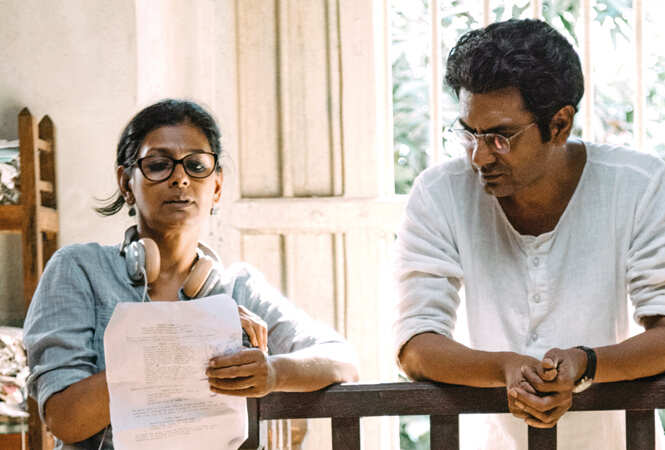
Nandita and Nawaz during the film’s shoot
Nandita and Nawaz during the film’s shoot
You’ve said that Manto’s writing was very accessible, and not just for intellectuals. But while making the film, how much are you veering into either territory, or not trying to? Have you kept today’s audience in mind while making the film and potentially risked diluting your vision, or gone ahead with your vision? Or it’s not an either/or?I don’t think I dissected it like that, in the sense that I’ve tried to be true to the story, but the reason I’m doing the film in the first place is to respond to today. So I see that connection between, sort of documenting and chronicling that past, but with the relevance of today. In terms of the language, maybe I’ve tried to keep today’s audience in mind a little bit, because I wanted to be true and authentic to that period and his own words. Ninety percent of the dialogues are from his writings. Of course you can’t copy-paste, you have to really weave it in, and sometimes change one word to make it easier. But when you go to Lahore, a Maulana or a judge have to speak in a certain way. So I’ve not diluted, but I’ve kept it in a way that you understand the context. You may not understand that particular word, like ‘fahash’, which means obscenity. Woh itna aata hi hai, because he was tried for obscenity. Main ussko ‘ashleel’ nahi bol sakti hoon, it has to be ‘fahash’. But in the context, you will understand that it means obscenity. Ya ‘adab’, jo bahut aasaan Urdu ka lafz hai, lekin log nahi jante ki ‘adab’ is literature. Lekin woh uss context mein hai ki aapko pata chal jayega ki woh literature ki baat kar rahe hain. And I’ve also kept subtitles for India, so that it’s easy. So that fine line between making a language accessible to today’s audience, and at the same time being authentic to that period, was something I took time with.
Manto’s writing was considered provocative because he wasn’t sanitising what he saw. But for a film, how much are you sanitising, for different levels – A, for the CBFC and what rating you’re going for; B, for the cinema audience and how much it can actually take; and C, for ‘super censors’ and ‘hurt sentiments’?Firstly, I’m dead against any form of censorship, I’m definitely against self-censoring. I think no art, no creativity, no authentic intent can come out if you start thinking of where you’re going to put your barricades. So I don’t think I’ve done that at all. In terms of the Censor Board, we got a U/A certificate, which is great, which is what we wanted. Of course they had their 20 points, and I argued my case with each point. And they as individuals really liked the film. So I think they understood it, they were just trying to go with the guidelines – which are in some sense ambiguous. And there are so many things that I find terribly regressive, that I think should be censored! But once you’re a champion of freedom of expression, you can’t say that the things I don’t like, you should censor. We have no visual cuts, which is great. Language cuts – literally two or three words. And they asked me to replace them, I said no, I’m going to beep them. Because I want the audience to know what is not kosher for them. And Manto khud kehte thay ki main apne kirdaaron se wohi zubaan bulwata hoon jo woh bolte hain. To make your characters authentic, they have to speak a certain way. And these words that have been cut, are words that Manto used.
In terms of the self-proclaimed custodians of culture, I don’t think there’s actually something hugely controversial as such. In the sense that what was controversial 70 years ago, if that’s still going to be so, that’s crazy. Manto was controversial then, hopefully we’re celebrating him now. I’ve gone through it with 'Fire', with 'Water', with 'Firaaq', so hopefully, I won’t have to go through it again. It’s the story of a writer, of an artist, and it’s a very personal, intimate story. I’m not giving any big bhashan. And my idea is not to sensationalise or scandalise, or portray him in the way Manto has been projected. He’s also been projected as this, ‘oh he used to write about these very sexual things, etc etc’. He was also deeply sensitive, he went through a lot of dilemmas. What was the angst of such a person, the moral dilemmas? Where you want to be a really good father and husband and at the same time, you want to tell the truth. Those are the things I have explored.
The director of the Pakistani film on Manto, Sarmad Khoosat, said that he ‘sublimated’ a lot of the brutality in Manto’s stories, and used metaphors instead. A review from Cannes for your film called it “almost too respectable to do justice to the scathing and sexually provocative nature of Manto’s stories”. Now, those who love Manto say his stories are like a punch to the gut. In trying to stay within the confines that exist in cinema, do you think you have had to risk softening that punch? And does that risk disappointing the audience that loves him?I don’t know whether it’s softening. If being able to see gore and blood in a story of Partition – which was there. Let’s say 'Thanda Gosht', Ishar Singh goes through the riots and he kills people... I’ve not first of all shown the whole story. I’ve shown glimpses of every story just to give you that flavour. As an audience, I don’t find that interesting, to be honest. For me, glorifying violence – maybe that’s just where I am in my life, even to be angry I feel adds to that violence, and I’m struggling with it. Because I do get angry at things, and I don’t want to add to the violence in the world. How do I calm down, be less judgmental – it’s a struggle… Half-baked knowledge about Manto is also dangerous. When you read one article and you think Manto was all about sexuality, violence, he was raw… Of course he was raw. But that rawness comes with a great amount of sensitivity, comes with just making things be seen as they are. Which means being truthful, it doesn’t necessarily mean more gory, or more sexual or provocative for the sake of it. So I don’t think that’s respectful because I have shown Manto with the greyest of characters, with all his warts and blemishes. I’ve not put him on a pedestal, which in fact has been the common feedback. Different people will have their different take on it, some might think of it as too soft, some might think, ‘wow’, who’re probably seeing his stories for the first time, like a 'Toba Tek Singh' or 'Thanda Gosht' or 'Khol Do'. But that’s what cinema is about.
Nandita Das: A film on Manto doesn't have to be gory
"Get the latest updates on Times of India, including reviews of the movie
Coolie and
War 2."